Introduction
Artificial intelligence has become a part of our daily lives in ways many of us never imagined a few years ago. From voice assistants and recommendation systems to self driving cars and AI writing tools, we interact with intelligent technology almost every day. When I first started learning about artificial intelligence, I kept hearing two terms again and again: Machine Learning and Deep Learning. At first, I thought they meant exactly the same thing. The more I explored, the more I realized they are closely connected but very different in how they work.
In my experience, understanding the difference between machine learning and deep learning makes it much easier to understand how modern AI systems actually function. Both technologies are changing industries, helping businesses make better decisions, and making everyday life more convenient. However, they solve problems in different ways and each has its own strengths and limitations.
In this article, I will explain machine learning and deep learning in simple English. I will also share practical examples so you can clearly understand when each approach works best and why both are important in the world of artificial intelligence.
What Is Machine Learning?
Machine learning is a branch of artificial intelligence that allows computers to learn from data instead of being programmed with fixed rules. Instead of telling a computer every single step, we provide it with examples, and it learns patterns on its own.
When I first learned about machine learning, I imagined teaching a child to recognize fruits. Instead of describing every detail of an apple, I simply show many pictures of apples. Over time, the child starts recognizing apples without needing further explanation. Machine learning follows a similar idea.
For example, if you want an email application to detect spam messages, you can train a machine learning model using thousands of emails marked as spam or not spam. After enough training, the system becomes capable of identifying suspicious emails on its own.
Machine learning depends heavily on the quality of data. Better data usually leads to better predictions and more accurate results.
How Machine Learning Works
The process of machine learning is easier than many people think. It starts with collecting relevant data. This data is then cleaned and organized before being used to train a model.
During training, the algorithm studies patterns inside the data. After training is complete, the model is tested with new information to check how accurately it performs. If the results are not good enough, developers improve the model and train it again.
In my experience, this process requires patience because improving accuracy often takes multiple attempts. Small improvements in data quality can sometimes make a huge difference in performance.
Common Types of Machine Learning
Machine learning is generally divided into several categories.
Supervised Learning
This is the most common type. The model learns using labeled data where the correct answer is already known.
For example, if we want to predict house prices, we provide the model with information about thousands of houses along with their selling prices. Eventually, it learns how different features affect price.
Unsupervised Learning
In this method, the computer receives data without labels. Its job is to discover hidden patterns or groups within the data.
Businesses often use unsupervised learning to group customers with similar shopping habits.
Reinforcement Learning
In reinforcement learning, the computer learns through rewards and mistakes. Every good decision earns a reward while poor decisions receive a penalty.
This approach is widely used in robotics, gaming, and autonomous vehicles.
What Is Deep Learning?
Deep learning is a specialized branch of machine learning that uses artificial neural networks inspired by the human brain. Instead of relying heavily on human designed features, deep learning models automatically discover important patterns from large amounts of data.
When I first saw deep learning in action, I was amazed by how accurately it could recognize faces, understand speech, and even generate realistic images. These tasks are extremely difficult using traditional machine learning methods.
Deep learning has become one of the biggest reasons behind the recent explosion of AI technologies.
How Deep Learning Works
Deep learning uses multiple layers of artificial neurons. Each layer processes information and passes it to the next layer.
Imagine looking at a photo of a cat. The first layer may recognize simple edges. The next layer identifies shapes like ears and eyes. Another layer combines these features and finally recognizes the entire cat.
This layered learning process allows deep learning models to solve highly complex problems.
Although the concept sounds simple, training these networks requires massive computing power and enormous amounts of data.
Neural Networks Explained Simply
Neural networks are the foundation of deep learning.
Each artificial neuron receives information, performs calculations, and passes the result to the next neuron. Thousands or even millions of these neurons work together.
I like comparing this process to a large team working on a project. Every person handles a small task, and together they complete something much bigger.
As neural networks become deeper with more layers, they become capable of learning increasingly complex relationships.
Key Differences Between Machine Learning and Deep Learning
Although deep learning belongs to machine learning, there are several important differences.
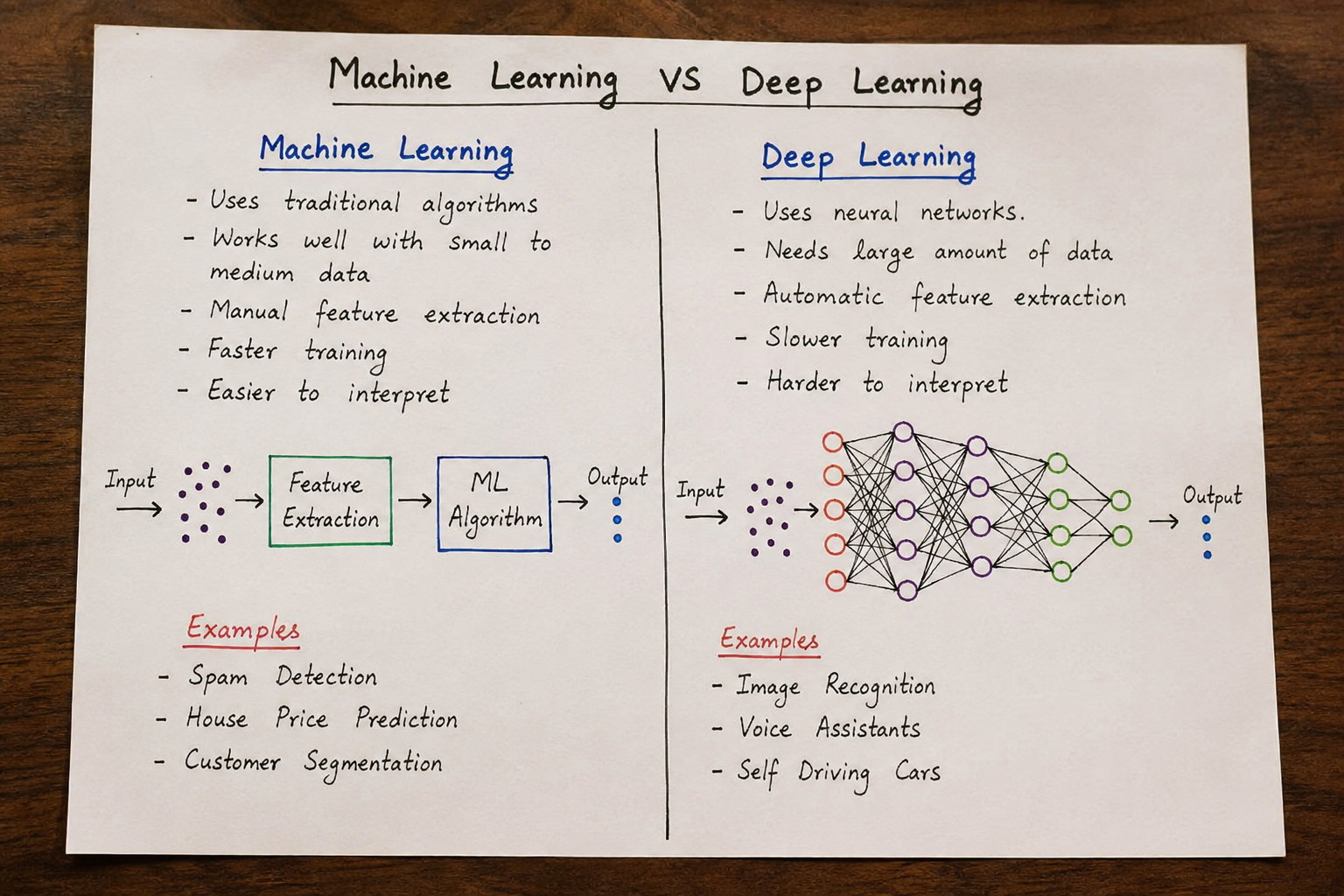
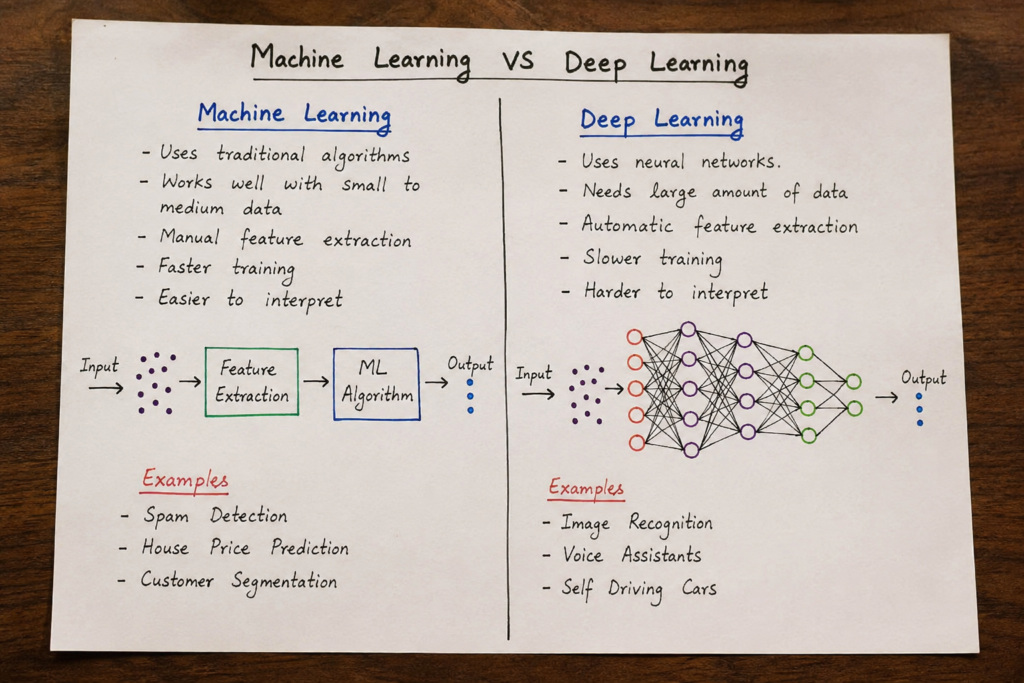
Machine learning often performs well with smaller datasets, while deep learning usually requires millions of examples for the best results.
Machine learning frequently depends on human experts selecting useful features from data. Deep learning automatically learns these features during training.
Machine learning models usually train faster and require less powerful computers. Deep learning often needs high performance GPUs and much longer training times.
Machine learning models are generally easier to understand because developers can often explain why they made certain predictions. Deep learning models are more difficult to interpret since millions of calculations happen behind the scenes.
Machine learning is suitable for structured data like spreadsheets and databases. Deep learning performs exceptionally well with images, videos, speech, and natural language.
Machine Learning Applications
Machine learning is already part of many products we use every day.
Banks use machine learning to detect fraudulent transactions before customers even notice suspicious activity.
Online stores recommend products based on previous purchases.
Healthcare providers use machine learning to predict disease risks.
Weather forecasting systems improve predictions using machine learning models.
Marketing teams analyze customer behavior and improve advertising campaigns.
Whenever I shop online, I notice product recommendations becoming more accurate over time. That is machine learning working quietly in the background.
Deep Learning Applications
Deep learning powers many advanced AI systems that seemed impossible just a decade ago.
Facial recognition systems unlock smartphones.
Voice assistants understand spoken commands.
Translation tools convert languages almost instantly.
Medical imaging systems detect diseases with impressive accuracy.
Self driving cars recognize roads, traffic signs, pedestrians, and surrounding vehicles.
AI image generators create realistic artwork.
Large language models can answer questions, summarize information, and generate high quality text.
These impressive capabilities are possible because deep learning can understand highly complex patterns in enormous datasets.
Advantages of Machine Learning
One reason I appreciate machine learning is its efficiency.
It requires less computing power than deep learning.
It works well even with moderate amounts of data.
Training time is generally much shorter.
The models are easier to explain and debug.
Development costs are often lower.
For many business problems, machine learning provides excellent performance without the complexity of deep learning.
Advantages of Deep Learning
Deep learning shines when dealing with complicated tasks.
It automatically learns useful features without requiring extensive manual work.
It achieves remarkable accuracy in image recognition, speech processing, and language understanding.
Performance often improves as more data becomes available.
It handles unstructured information extremely well.
Many modern AI breakthroughs would not have been possible without deep learning.
Limitations of Machine Learning
Despite its strengths, machine learning has some challenges.
It often requires careful feature engineering by experienced developers.
Performance may stop improving after reaching certain limits.
Complex visual and language tasks can be difficult.
Accuracy sometimes depends heavily on the quality of manually selected features.
Limitations of Deep Learning
Deep learning also comes with challenges.
Training can take hours, days, or even weeks.
It requires expensive hardware such as GPUs.
Large amounts of labeled data are usually necessary.
The models consume significant electricity and computing resources.
Understanding why a deep learning model makes certain decisions is often difficult.
From my experience, these limitations explain why many companies still choose traditional machine learning for simpler business applications.
Which One Should You Choose?
The right choice depends on the problem you are trying to solve.
If your data is structured, limited in size, and your goal is prediction or classification, machine learning is often the smarter option.
If you are working with images, videos, speech, or natural language and have access to large datasets and powerful hardware, deep learning usually delivers better results.
I have noticed that many beginners assume deep learning is always the better choice simply because it is more advanced. In reality, using deep learning for every project can increase costs without providing meaningful improvements. Choosing the simplest solution that solves the problem effectively is often the best decision.
The Future of Machine Learning and Deep Learning
Artificial intelligence continues to evolve rapidly. Every year we see better algorithms, faster hardware, and larger datasets.
Machine learning will remain valuable because many businesses need fast, affordable, and reliable solutions.
Deep learning will continue driving innovations in robotics, healthcare, autonomous transportation, cybersecurity, education, and creative industries.
I also believe future AI systems will combine the strengths of both approaches instead of relying on only one. Researchers are already developing hybrid models that offer better efficiency while maintaining high accuracy.
As technology becomes more accessible, even small businesses will be able to use AI tools that once required massive investments.
Final Thoughts
When I first started exploring artificial intelligence, I assumed machine learning and deep learning were interchangeable terms. After learning how each technology works, I realized they solve problems in different ways while sharing the same goal of helping computers learn from data.
Machine learning is practical, efficient, and perfect for many everyday business problems. Deep learning takes things a step further by handling highly complex tasks involving images, speech, and language. Neither approach is universally better. The best choice depends on the type of data, available resources, and the specific problem you want to solve.
As artificial intelligence continues transforming industries around the world, understanding the difference between machine learning and deep learning becomes increasingly valuable. Whether you are a student, business owner, developer, or simply curious about technology, learning these concepts will help you better understand the intelligent systems shaping our future.