Introduction
When I first heard about Python programming, I honestly thought coding was only for computer experts and software engineers. I believed I would need advanced mathematics, years of study, and expensive courses before I could write even a simple program. Thankfully, I was completely wrong. Python turned out to be one of the easiest programming languages to understand, and it completely changed the way I looked at technology.
If you are just starting your programming journey, I can confidently say that Python is one of the best places to begin. It is simple, readable, and incredibly powerful. Whether you want to build websites, automate boring tasks, create games, analyze data, or even work with artificial intelligence, Python gives you a strong foundation.
In this article, I want to share my experience of learning Python from the beginning. Instead of using complicated technical language, I will explain everything in a simple way that I wish someone had explained to me when I started.
What Is Python?
Python is a high level programming language that was created by Guido van Rossum and released in 1991. Since then, it has become one of the most popular programming languages in the world.
The reason behind its popularity is very simple. Python focuses on readability. The code looks almost like plain English, making it easier for beginners to understand.
When I wrote my first Python program, I was surprised by how little code was needed. Compared to some other programming languages, Python removes unnecessary complexity so you can focus on solving problems rather than worrying about confusing syntax.
Why I Chose Python
There are hundreds of programming languages available today, so choosing the right one can feel overwhelming. I spent several days researching before deciding on Python.
Here are the reasons why I picked it.
Easy to Learn
The biggest advantage was its simple syntax. Even without a computer science background, I was able to understand basic concepts within a few days.
Huge Community
Whenever I got stuck, I discovered thousands of tutorials, videos, discussion forums, and blog posts that helped me solve my problems.
Versatile Language
I also liked the fact that Python is not limited to one field. Learning Python opens doors to web development, automation, cybersecurity, artificial intelligence, machine learning, data science, and many other industries.
High Demand
Another motivating factor was seeing how many companies look for Python developers. Knowing that this skill has real career value made learning it even more exciting.
Installing Python
Installing Python was much easier than I expected.
I visited the official Python website, downloaded the latest version, and completed the installation within a few minutes.
One important thing I learned during installation was to check the option that adds Python to the system path. This small checkbox saved me from many problems later.
After installation, I opened the command prompt and typed:
python --version
Seeing the version number appear on my screen gave me confidence that everything was working correctly.
Choosing a Code Editor
Python programs can be written in any text editor, but using a good code editor makes everything easier.
I started with Visual Studio Code because it is lightweight, free, and offers excellent Python support.
Some beginners also use:
Python IDLE
PyCharm Community Edition
Sublime Text
Spyder
The editor itself is not the most important thing. The important part is writing code consistently.
Writing the First Python Program
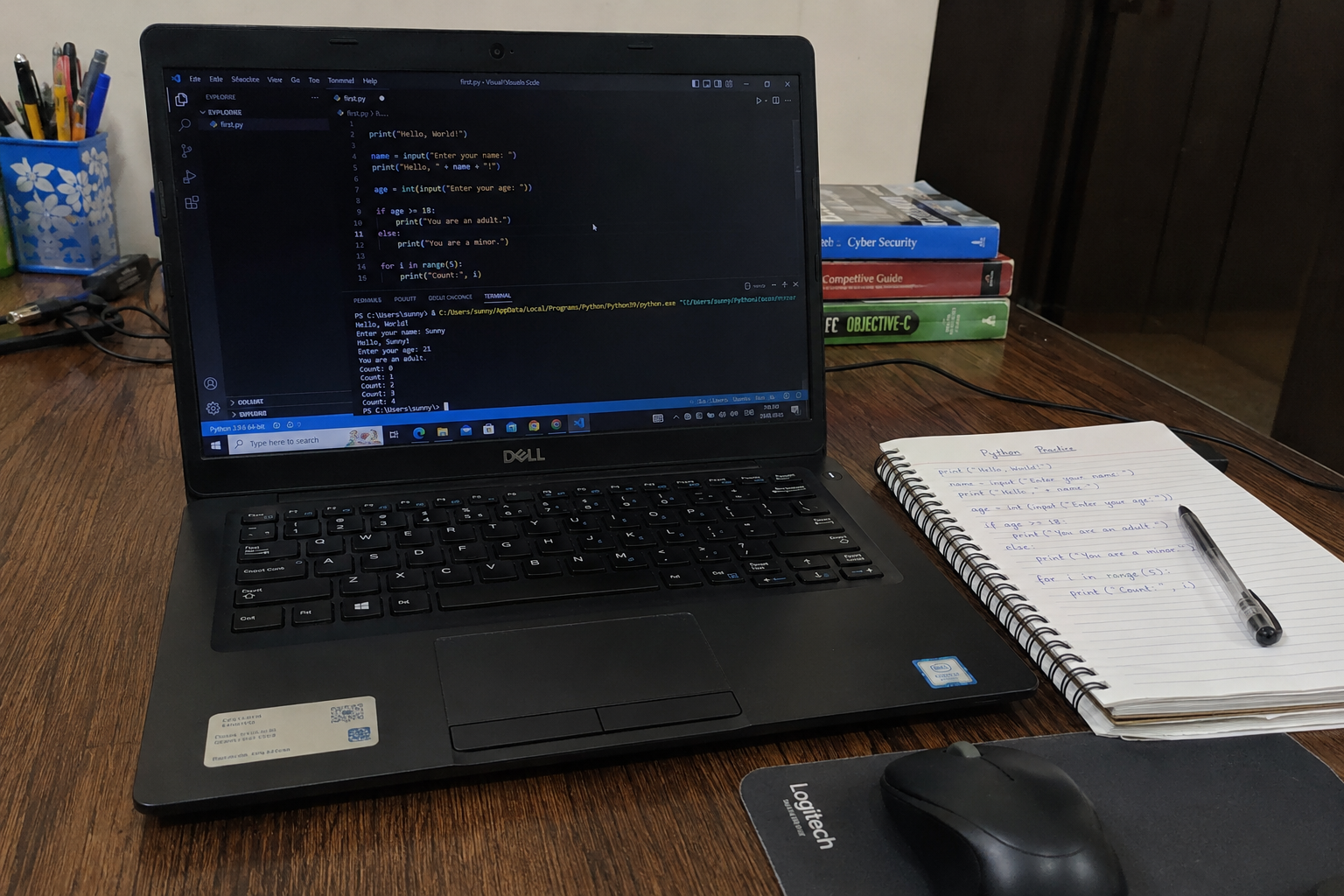
Like almost every beginner, my first program displayed a simple message.
print("Hello, World!")
When I pressed the Run button and saw those words appear on the screen, I felt surprisingly excited.
It was a tiny achievement, but it proved that I had successfully written my first computer program.
Everyone starts somewhere, and this simple example marks the beginning of an amazing learning journey.
Understanding Variables
Variables store information that your program can use later.
For example:
name = "Kevin"
age = 25
country = "Pakistan"
Now these values can be used anywhere in the program.
print(name)
print(age)
print(country)
I found variables very easy to understand because they work like labeled boxes where you store information.
Learning Data Types
Python supports different kinds of data.
Some common data types include:
String
language = "Python"
Integer
students = 40
Float
price = 19.99
Boolean
is_online = True
Learning data types helped me understand what kind of information my programs were working with.
Taking User Input
One of the most interesting things I learned was accepting input from users.
name = input("Enter your name: ")
print("Welcome", name)
Instead of displaying the same message every time, the program becomes interactive.
This was the moment when programming started feeling much more practical.
Using Operators
Python includes many operators for calculations.
Addition
10 + 5
Subtraction
10 - 5
Multiplication
10 * 5
Division
10 / 5
I practiced these operators by creating small calculator programs.
Building tiny projects helped me remember concepts much better than simply reading tutorials.
Making Decisions with If Statements
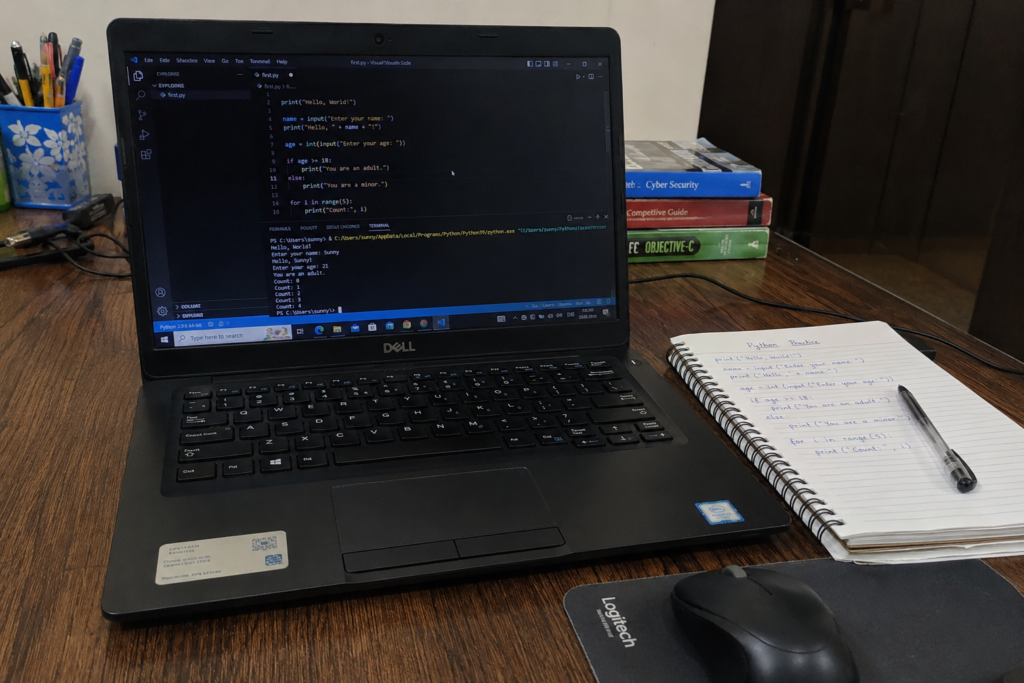
Programs often need to make decisions.
Python uses if statements for this purpose.
age = 18

if age >= 18:
    print("You can vote.")
You can also use else.
age = 15

if age >= 18:
    print("Adult")
else:
    print("Minor")
Learning conditions made my programs smarter because they could respond differently depending on different situations.
Understanding Loops
Repeating tasks manually becomes boring very quickly.
Loops solve this problem.
For Loop
for i in range(5):
    print(i)
While Loop
count = 1

while count <= 5:
    print(count)
    count += 1
When I understood loops, I realized how programmers automate repetitive work.
Creating Functions
Functions allow you to organize your code.
Instead of writing the same code repeatedly, you write it once and reuse it.
def greet():
    print("Welcome to Python.")
Calling it is simple.
greet()
Functions made my programs cleaner and much easier to manage.
Working with Lists
Lists store multiple values together.
fruits = ["Apple", "Banana", "Orange"]
You can access items like this.
print(fruits[0])
You can also add new items.
fruits.append("Mango")
Lists became one of my favorite Python features because they are used almost everywhere.
Dictionaries
Dictionaries store information in key value pairs.
student = {
    "name": "Ali",
    "age": 20,
    "city": "Lahore"
}
Accessing values is simple.
print(student["name"])
Dictionaries helped me organize related information more efficiently.
Learning from Mistakes
One lesson I learned very early was that errors are completely normal.
Almost every beginner faces problems like:
Missing quotation marks
Incorrect indentation
Misspelled variable names
Forgotten brackets
Instead of getting frustrated, I started reading the error messages carefully.
Most of the time, Python actually tells you where the mistake happened.
Over time, fixing bugs became one of the best ways to improve my programming skills.
Small Projects Help the Most
Watching tutorials is useful, but real learning begins when you start creating projects.
Some beginner projects I built included:
Simple calculator
Number guessing game
Password generator
To do list
Temperature converter
Age calculator
Each project introduced new concepts while helping me practice old ones.
Practicing Every Day
I quickly realized that consistency matters more than long study sessions.
Even spending thirty minutes each day writing code improved my skills.
Some days I only solved one small problem.
Other days I built complete mini projects.
The important thing was continuing to practice without taking long breaks.
Programming is similar to learning a new language. The more you use it, the more natural it becomes.
Helpful Python Libraries
One of Python’s biggest strengths is its enormous collection of libraries.
Some useful beginner libraries include:
Math for mathematical calculations.
Random for generating random values.
Datetime for working with dates and time.
OS for interacting with the operating system.
Tkinter for creating desktop applications.
As I became more comfortable, I also explored libraries for data science, web development, and automation.
Common Beginner Mistakes
Looking back, I made many mistakes during my first few weeks.
I tried learning everything at once.
I watched too many tutorials without practicing.
I copied code without understanding it.
I gave up quickly whenever I encountered an error.
Eventually I realized that making mistakes is actually part of becoming a better programmer.
Every bug teaches something valuable.
Resources That Helped Me Learn
I learned Python using a combination of different resources.
Official documentation
YouTube tutorials
Coding practice websites
Programming books
Online communities
Discussion forums
Using multiple learning sources helped me understand concepts from different perspectives.
Staying Motivated
Learning programming is exciting at first, but there will be moments when things become difficult.
There were days when I spent hours trying to fix one tiny mistake.
At those moments, I reminded myself how much progress I had already made.
Instead of comparing myself with experienced developers, I focused on becoming slightly better than I was yesterday.
That mindset made learning much more enjoyable.
Where Python Can Take You
After learning the basics, many exciting career paths become available.
You can become a web developer.
You can work in data science.
You can build artificial intelligence applications.
You can automate business tasks.
You can create desktop software.
You can develop games.
You can enter cybersecurity.
Python is one language that opens countless opportunities across different industries.
Tips for New Python Learners
If I could give advice to someone starting today, it would be this.
Start with the basics before moving to advanced topics.
Write code every day.
Build small projects.
Do not fear errors because they are part of learning.
Read other people’s code.
Practice solving problems regularly.
Stay patient because improvement comes gradually.
Celebrate small achievements because they build confidence.
Conclusion
Learning Python has been one of the most rewarding skills I have ever developed. What seemed impossible in the beginning slowly became enjoyable through consistent practice and curiosity. I started with simple print statements, struggled with errors, celebrated small victories, and gradually built projects that I never imagined I could create.
The best part about Python is that you do not need to be a genius to learn it. You only need patience, regular practice, and a willingness to keep improving. Every experienced programmer was once a beginner who wrote their first line of code and made plenty of mistakes along the way.
If you are thinking about starting your programming journey, my advice is simple. Download Python, write your first program today, and keep learning one step at a time. The progress may feel slow in the beginning, but every line of code you write brings you closer to becoming a confident programmer. With dedication and consistent effort, Python can become the skill that opens countless personal, academic, and career opportunities for your future.